
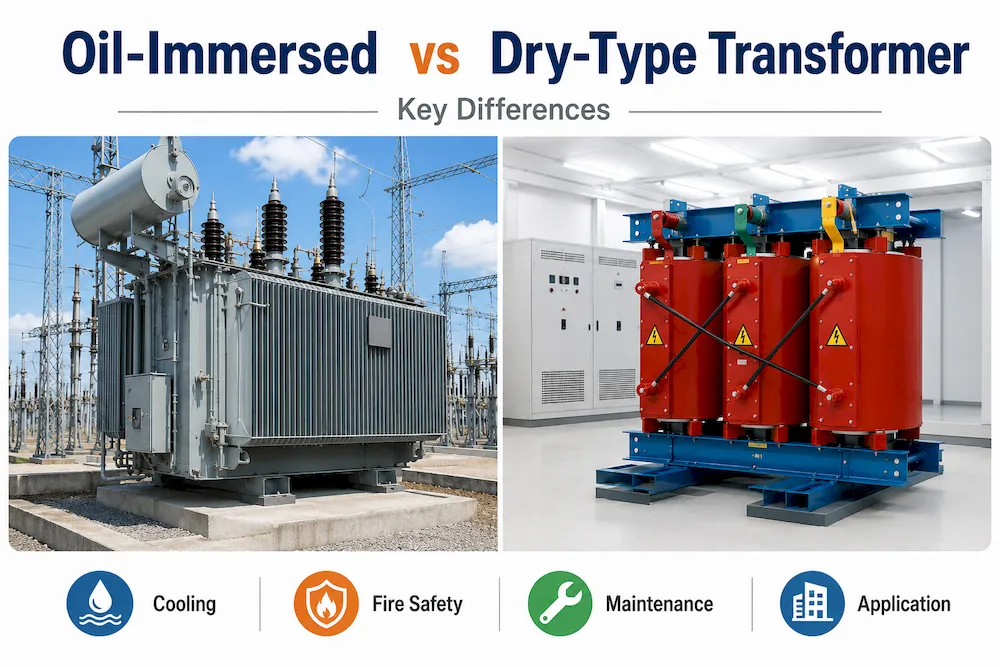
Oil-immersed vs dry-type transformer selection is an important decision for any power-distribution, industrial, commercial or renewable-energy project. Both transformer types provide reliable voltage conversion, but they use different cooling and insulation systems and are suited to different installation environments.
An oil-immersed transformer uses insulating liquid for cooling and electrical insulation. A dry-type transformer uses air and solid insulation materials, often including cast-resin windings. Understanding the differences helps project teams choose equipment that matches capacity, safety, maintenance, environmental and budget requirements.
Oil-Immersed vs Dry-Type Transformer: The Main Difference
The main difference is the insulation and cooling medium. Oil-immersed transformers use insulating oil to transfer heat away from the windings and core. Dry-type transformers use air and solid insulation systems to manage heat and protect the windings.
This design difference affects cooling performance, fire risk, installation location, maintenance requirements, project cost and available capacity range.
1. Cooling Performance
Oil is highly effective at removing heat from transformer windings. For this reason, oil-immersed transformers are commonly used for high-capacity, heavy-load and outdoor applications. The oil transfers heat from the active parts to the tank, radiators and cooling equipment.
Dry-type transformers usually use natural-air cooling or forced-air cooling. They can perform well in many commercial and industrial applications, but they generally require adequate ventilation and may need more installation space for the same capacity.
When comparing oil-immersed vs dry-type transformer cooling performance, oil-immersed units are often preferred where high capacity, continuous loading or demanding outdoor conditions are the main priorities.
2. Fire Safety and Environmental Considerations
Dry-type transformers are often selected for indoor locations because they do not contain insulating oil. This reduces the risk associated with oil leakage and can simplify fire-protection planning in some projects.
They are commonly used in hospitals, schools, shopping centers, offices, tunnels, airports, data centers and other locations close to people or sensitive equipment.
Oil-immersed transformers can also operate safely when they are correctly designed, installed and maintained. However, projects may require additional measures such as fire walls, oil-containment systems, drainage arrangements, fire detection or fire-suppression systems.
3. Capacity and Project Application
Oil-immersed transformers are widely used in utility networks, outdoor substations, industrial facilities, mining projects, solar farms and wind farms. Their cooling capability makes them suitable for many medium-voltage, high-voltage and large-capacity applications.
Dry-type transformers are commonly used where indoor installation, lower fire risk and simplified maintenance are more important than maximum capacity. They can be installed close to the electrical load, which may reduce cable length and distribution losses.
- Oil-immersed transformer: substations, utility networks, outdoor sites and high-capacity projects
- Dry-type transformer: indoor substations, buildings, data centers and fire-sensitive locations
For indoor or fire-sensitive applications, explore our dry-type transformer solutions.
4. Maintenance Requirements
Oil-immersed transformers require periodic inspection of the insulating oil, seals, cooling system and tank condition. Operators may need to monitor oil level, oil quality, moisture content, dissolved gases and potential leakage, depending on the transformer rating and maintenance plan.
Dry-type transformers generally require less oil-related maintenance because they do not use insulating liquid. However, they still need regular cleaning, terminal inspection, temperature monitoring and ventilation checks.
In an oil-immersed vs dry-type transformer comparison, the correct maintenance choice depends on the available site personnel, operating environment and the project’s long-term maintenance strategy.
5. Installation Location and Space
Oil-immersed transformers are often installed outdoors or in dedicated transformer rooms. They may need space for radiators, oil-containment systems, fire-protection equipment and maintenance access.
Dry-type transformers are often easier to place inside buildings, electrical rooms and areas near the load center. However, they still require sufficient ventilation, clearance and access for inspection.
- Indoor or outdoor installation location
- Available floor space and maintenance access
- Ambient temperature and altitude
- Dust, humidity, salt air and corrosion conditions
- Ventilation and cooling requirements
- Fire-safety and environmental requirements
6. Cost and Total Project Value
Oil-immersed transformers are often more economical for larger-capacity applications. Their initial purchase price can be competitive, particularly where strong cooling and compact active-part design are required.
Dry-type transformers may have a higher initial cost for the same rating. However, they can reduce or simplify certain project costs related to fire protection, oil containment, indoor installation and routine oil maintenance.
The transformer price alone should not determine the decision. A complete evaluation should include installation cost, civil works, safety systems, energy losses, maintenance cost and expected service life.
7. How to Choose the Right Transformer
Choose an oil-immersed transformer when high capacity, outdoor installation, strong cooling and lower initial equipment cost are key requirements. It is often suitable for substations, industrial plants, utility networks and renewable-energy projects.
Choose a dry-type transformer when indoor installation, fire safety, low maintenance and operation near people or sensitive equipment are the main priorities.
When comparing oil-immersed vs dry-type transformer options, confirm the project’s rated capacity, voltage combination, installation environment, safety requirements, cooling method, harmonics, noise limits and applicable standards before ordering.
Technical Parameters to Confirm Before Ordering
- Rated capacity and expected load profile
- Primary and secondary voltage
- Frequency, vector group and impedance
- Tap-changer requirement
- Cooling method and temperature-rise limit
- Installation altitude and ambient temperature
- Protection level, enclosure and corrosion resistance
- Testing requirements and applicable standards
- Required accessories and monitoring systems
For projects requiring large-capacity grid equipment, see our 345kV fully insulated transformer solution. For solar, wind and energy-storage applications, read our guide to renewable-energy transformer solutions.
Standards and Final Selection
The final transformer selection should be based on the approved project specification and applicable local standards. International projects may reference IEC, ANSI, GB or utility-specific technical requirements.
For general information about international electrotechnical standards, visit the International Electrotechnical Commission.
Conclusion
Oil-immersed vs dry-type transformer selection is not about choosing one universally better option. Oil-immersed transformers usually provide strong cooling and are widely used for large outdoor and high-capacity projects. Dry-type transformers offer lower fire risk and are often more suitable for indoor or fire-sensitive environments.
The right solution depends on project capacity, voltage, installation location, safety requirements, maintenance capability, environment and total lifecycle cost. Yawei Transformer can provide customized solutions for utility, industrial, commercial and renewable-energy applications.
 English
  Spanish
  Arabic
  French