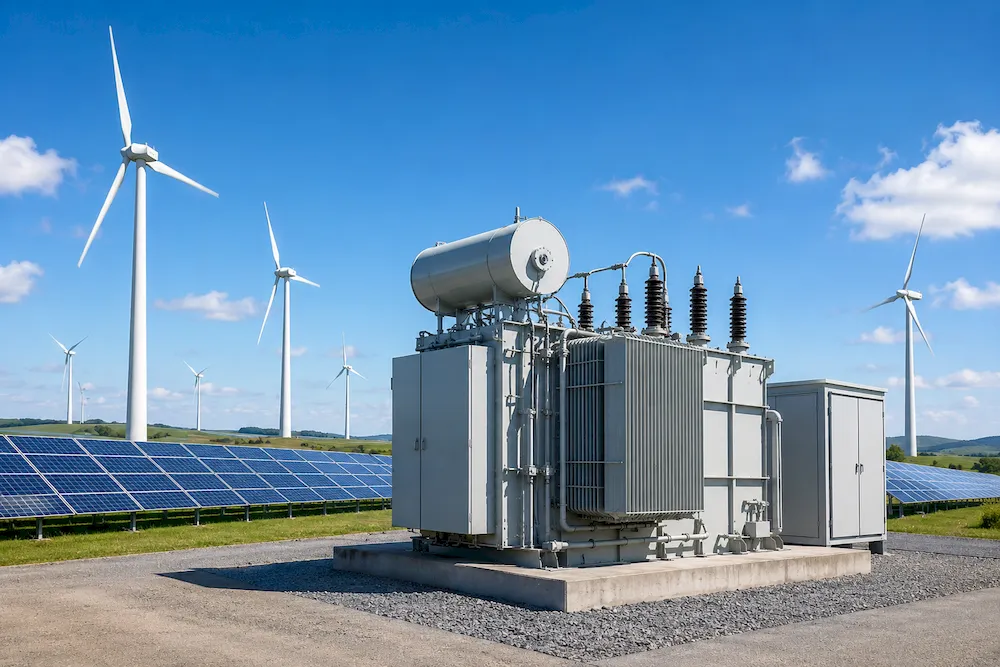
A power transformer is a key component in solar, wind and energy-storage projects. It converts electricity to the voltage required by the collection system, substation or public grid, helping renewable-energy projects operate safely and efficiently.
Solar panels, wind turbines and battery systems do not always produce electricity at the voltage used by the local grid. A correctly specified power transformer adjusts the voltage, supports electrical isolation and helps reduce transmission losses between the generation source and the grid-connection point.
How a Power Transformer Supports Renewable Energy Projects
A power transformer is used throughout renewable-energy systems, from inverter stations and wind-turbine collection networks to main substations and high-voltage grid-connection facilities.
Its primary function is to increase or reduce voltage according to the project design. In a solar farm, electricity generated by inverters is typically stepped up before it enters the collection network. In a wind farm, transformers raise generator voltage so electricity from multiple turbines can be transmitted to the main substation.
Without suitable transformer equipment, a renewable-energy project may experience increased electrical loss, voltage mismatch, unstable operation or difficulty meeting grid-connection requirements.
1. Power Transformer Solutions for Solar Power Projects
Solar panels generate direct current electricity. Inverters convert this electricity into alternating current, but the resulting voltage may still be lower than the voltage required by the local collection system or public grid.
A power transformer increases the inverter output voltage to the required level. Depending on the project, common voltage combinations may include 400V, 690V or 1kV on the low-voltage side and 10kV, 20kV, 33kV or 35kV on the medium-voltage side.
Solar Inverter Step-Up Transformers
Inverter step-up transformers are installed near inverter stations or within prefabricated power-conversion systems. They support efficient power transfer from solar arrays to the project collection network.
For large solar farms, several inverter transformers may feed a central substation. A main transformer then raises the voltage again before electricity is transferred to the transmission grid.
Key Solar Project Considerations
- Inverter voltage and rated output capacity
- Grid-connection voltage requirements
- Harmonic conditions from power electronics
- Outdoor temperature, dust, humidity and solar radiation
- Required efficiency, cooling method and protection level
2. Power Transformer Solutions for Wind Farms
Wind turbines generate electricity at a voltage that must be adjusted before the power enters the wind-farm collection network. A transformer may be installed in the nacelle, tower, base area or a nearby electrical station, depending on turbine design and project requirements.
Each wind-turbine transformer steps up the generator voltage to the collection-system voltage. Electricity from multiple turbines is then transmitted to a central substation, where a larger power transformer raises the voltage for connection to the regional grid.
Operating Conditions for Wind Power Transformers
Wind-power projects can involve vibration, changing generation output, restricted installation space and challenging weather conditions. Transformer selection should account for cooling requirements, insulation design, mechanical protection and maintenance access.
For offshore or coastal projects, corrosion protection, humidity resistance and transport planning are also important considerations.
3. Energy Storage and Grid-Connection Applications
Battery energy-storage systems also require transformer equipment. A power transformer connects the energy-storage converter system to the local grid and supports charging and discharging at the required voltage level.
Energy-storage transformers may operate with frequent load changes and power-electronic harmonics. Their design should consider the actual operating profile, thermal conditions, system impedance and protection requirements.
As grid-connected renewable-energy systems become more complex, transformer design must match the characteristics of inverters, converters, batteries and the local utility network.
4. Oil-Immersed or Dry-Type Power Transformer?
Both oil-immersed and dry-type transformer solutions can be suitable for renewable-energy projects. The correct choice depends on capacity, installation location, fire-safety requirements, maintenance conditions and environmental factors.
Oil-Immersed Transformers
Oil-immersed transformers are commonly used for outdoor solar farms, wind farms, high-capacity substations and large grid-connection projects. They offer effective cooling and are suitable for demanding continuous-duty applications.
- Large-capacity solar and wind projects
- Outdoor substations
- High-voltage grid connections
- Projects requiring strong cooling performance
Dry-Type Transformers
Dry-type transformers do not use insulating oil and are often selected for indoor or fire-sensitive locations. They can be suitable for inverter rooms, energy-storage buildings, commercial facilities and areas near personnel or other equipment.
Explore our dry-type transformer solutions for projects with strict fire-safety or indoor-installation requirements.
5. Important Power Transformer Selection Parameters
Before ordering a power transformer, the project team should provide complete technical information. This allows the manufacturer to recommend equipment that matches the electrical system and operating environment.
- Rated capacity and required overload capability
- Primary and secondary voltage
- Frequency and number of phases
- Vector group and impedance voltage
- Tap range and tap-changer requirement
- Cooling method and temperature-rise limits
- Harmonic level and inverter data
- Installation altitude and ambient temperature
- Applicable IEC, ANSI, GB or utility standards
- Monitoring, protection and accessory requirements
Testing and Quality Control
Renewable-energy projects require dependable long-term operation. Factory testing is therefore an important part of transformer supply and project acceptance.
Typical factory tests may include voltage-ratio testing, winding-resistance testing, insulation-resistance testing, no-load-loss testing, load-loss testing, impedance testing, applied-voltage testing and induced-voltage testing. Additional tests may be required depending on the project specification.
For high-voltage projects requiring advanced insulation verification, learn about the switching impulse test for power transformers.
Reliable Grid Connection for Clean Energy Projects
Modern electricity grids need reliable equipment to connect solar, wind and battery-energy-storage capacity. The International Energy Agency notes that grid expansion and modernization are essential for integrating growing renewable-energy capacity and maintaining secure electricity supply.
For background information on grid development and clean-energy integration, see the International Energy Agency’s electricity-grid report.
Conclusion
A power transformer is essential for converting voltage, reducing electrical losses and supporting safe grid connection in solar, wind and energy-storage projects. The correct solution depends on the generation technology, capacity, voltage level, location, environmental conditions and grid requirements.
Yawei Transformer provides customized transformer solutions for utility, industrial and renewable-energy applications. Visit our full transformer product range to explore suitable options for your project.
 English
  Spanish
  Arabic
  French