
Transformer Bushing Moisture Ingress: Lessons from a 110 kV Case
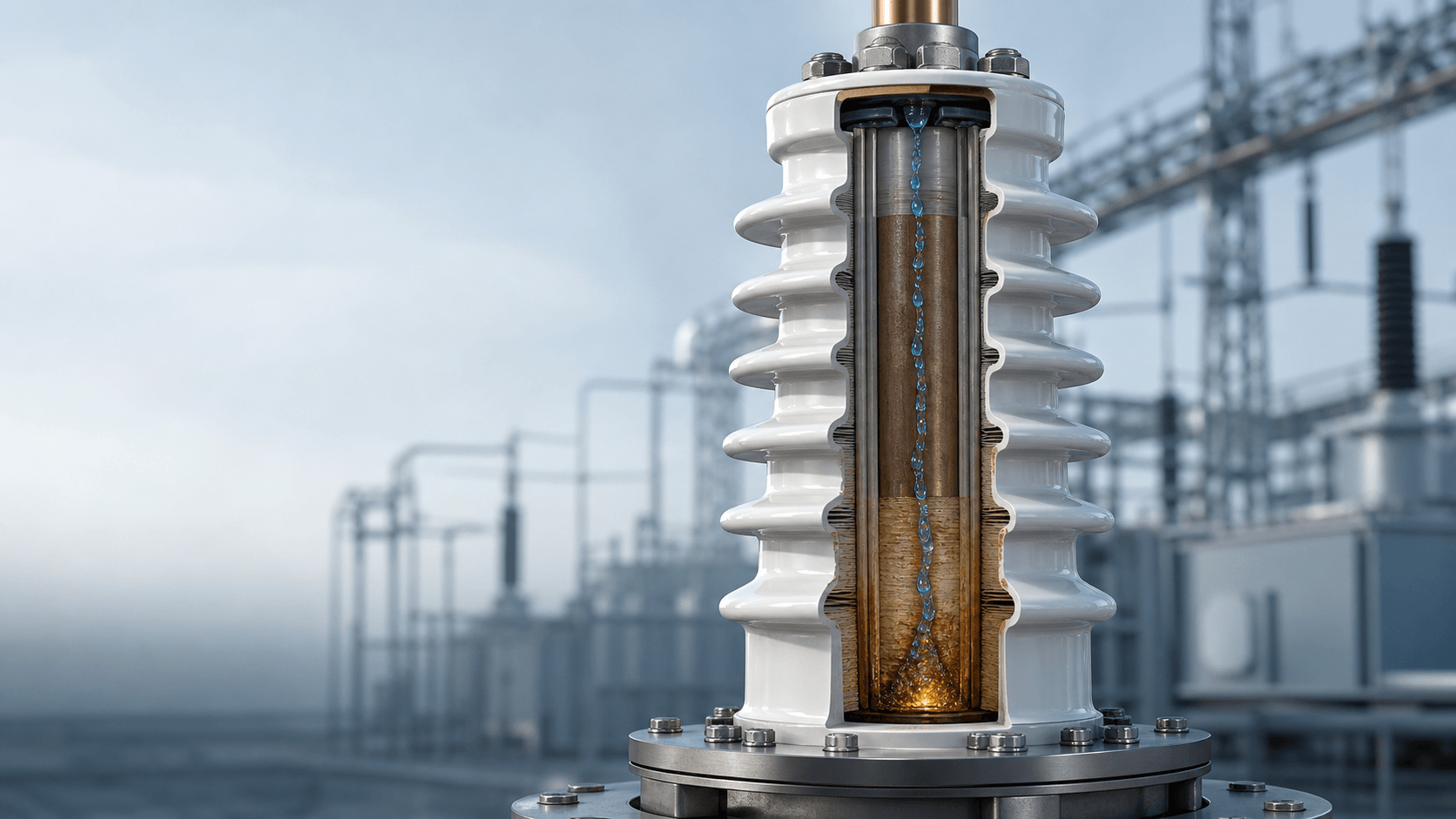
Moisture ingress can progressively weaken a condenser bushing without producing an obvious external defect. A historical 110 kV transformer case shows how changes in capacitance, dielectric loss, and insulation resistance identified a deteriorating bushing before it failed in service.
The main lesson is that reliable baseline data and historical trends can reveal developing insulation problems that may be missed when engineers evaluate only a single test result.
Technical note: This article analyzes one historical case for educational purposes. It does not establish universal alarm limits or maintenance instructions. Testing, acceptance criteria, and operating decisions should be reviewed by qualified engineers using the applicable standards, manufacturer documentation, and asset history.
How Was the Bushing Problem Discovered?
The problem was discovered during preventive testing of a 110 kV main transformer. Measurements associated with the B-phase high-voltage bushing differed significantly from both the other phases and results recorded approximately three years earlier.
The transformer did not initially show an obvious external fault. Investigators therefore needed to determine whether the abnormal measurements originated in the transformer active part, the tap changer, or an external high-voltage component such as the bushing.
Comparisons between phases and historical test results pointed to the B-phase condenser bushing. The bushing was removed and replaced before being dismantled for a detailed examination.
Which Measurements Changed?
The case demonstrates why transformer bushing condition should be evaluated using several indicators rather than a single measurement.
Main Insulation Capacitance
The main insulation capacitance of the B-phase bushing increased from 294.4 pF in the earlier test to 329.8 pF. The A- and C-phase bushings remained close to their previous values.
This phase-specific increase was important because a condenser bushing is designed as a controlled capacitive structure. A meaningful change in capacitance may indicate altered dielectric properties, damage to internal grading layers, or another change within the insulation system.
The measurement should always be evaluated against:
- The bushing’s own baseline data
- Comparable phase measurements
- Manufacturer information
- Test temperature and configuration
- Instrument accuracy and measurement repeatability
- Previous maintenance and operating history
A capacitance change is a diagnostic signal, not a complete diagnosis by itself.
Dielectric Loss or Power Factor
The reported dielectric-loss value for the B-phase main insulation increased from 0.300% to 1.965%. The lower-voltage or outer insulation section also showed a substantial increase.
Depending on regional practice and the test instrument, this type of measurement may be reported as dielectric dissipation factor, tan delta, or power factor. These terms describe closely related dielectric-loss behavior, but they should not be substituted without confirming the test method and reporting convention.
A rising dielectric-loss value may be associated with moisture, contamination, aging, internal discharge, or deterioration of the insulation system. Environmental conditions and surface leakage can also influence field measurements, especially on outdoor porcelain bushings.
Insulation Resistance
The insulation resistance associated with the affected section of the B-phase bushing was measured at 4,800 MΩ. Corresponding results for the A- and C-phase bushings were reported above 10,000 MΩ.
The transformer winding insulation also appeared lower than in the earlier test because the deteriorated bushing remained electrically connected during part of the testing.
This finding illustrates an important diagnostic challenge: a defective bushing can influence measurements that initially appear to indicate a problem inside the transformer.
Before attributing abnormal insulation results to the transformer active part, engineers need to understand the complete test circuit and determine whether bushings, tap changers, cables, or other connected components may be affecting the measurement.
What Did the Internal Examination Reveal?
When the condenser core was removed from the bushing, investigators found flashover tracking along its lower surface. Further dismantling revealed puncture damage in the first and second capacitive grading layers near the lower end.
Corrosion was also found on a compression spring near the top of the assembly. Together with the electrical measurements and the location of the internal damage, this supported a moisture-ingress mechanism.
The investigation concluded that moisture had entered through the upper portion of the bushing. Because the condenser core was installed vertically, moisture migrated downward along the outer insulation and accumulated near the lower, high-potential region.
Over time, the wet paper insulation changed the local electric-field distribution and supported surface discharge. Continued moisture migration into the condenser body eventually contributed to puncture of the internal grading layers.
Why Does Moisture Change Bushing Capacitance?
A condenser bushing contains conductive grading layers separated by oil-impregnated paper or another insulation system. Its capacitance depends on the geometry of those layers and the dielectric properties of the materials between them.
Water has a much higher relative permittivity than mineral oil or dry oil-impregnated paper. When moisture enters the insulation, it can change the effective dielectric properties and increase measured capacitance even when the physical dimensions remain unchanged.
Moisture can also:
- Increase dielectric loss
- Reduce insulation resistance
- Distort the internal electric field
- Promote surface tracking
- Contribute to partial discharge
- Accelerate deterioration of paper insulation
- Increase the risk of internal puncture
The exact response depends on the location and quantity of moisture, temperature, bushing construction, contamination, test configuration, and the extent of existing deterioration.
Why Was Historical Trending So Important?
The absolute measurements were abnormal, but comparisons with previous results and the other phases made the diagnosis much stronger.
In this case:
- The A- and C-phase capacitance values remained close to their earlier results.
- The B-phase main capacitance increased by approximately 12%.
- The B-phase outer-section capacitance increased by approximately 9.7%.
- Dielectric-loss values increased substantially on the same phase.
- Insulation resistance decreased in the affected bushing section.
Outdoor humidity can influence dielectric-loss measurements through surface leakage across porcelain insulation. Capacitance may be less sensitive to that particular external influence under some test conditions, making it a valuable complementary indicator.
This does not mean capacitance is always more reliable than dielectric loss. The broader lesson is that engineers should combine repeatable measurements, environmental information, phase comparisons, historical trends, and knowledge of the bushing design.
What Can Transformer Owners Learn From This Case?
A Bushing Defect Can Look Like a Transformer Defect
A deteriorated bushing can affect measurements taken on the complete transformer. Engineers should isolate the test object correctly and understand which components are included in each measurement before identifying the fault location.
External Appearance Is Not Enough
The critical damage in this case was inside the condenser body. A visual inspection alone could not reveal moisture in the paper insulation or puncture of the internal grading layers.
Visual inspection remains useful for detecting leakage, corrosion, cracked porcelain, damaged seals, contamination, or abnormal heating, but it cannot confirm the internal condition of a condenser bushing.
Baseline Data Has Long-Term Value
Factory, commissioning, and periodic test records allow engineers to recognize changes that may otherwise appear insignificant.
A useful bushing condition record may include:
- Manufacturer, type, and serial number
- Installation date and transformer position
- Phase identification
- Capacitance values
- Power factor or tan delta
- Test voltage and temperature
- Measurement configuration
- Test-tap condition
- Instrument information
- Leakage or corrosion observations
- Thermal inspection results
- Previous alarms and fault exposure
- Maintenance and replacement history
Consistent test conditions make long-term comparisons more meaningful.
Phase Comparison Is Useful but Not Conclusive
Comparing the three phases can quickly highlight an abnormal bushing. However, apparently similar bushings may differ in age, construction, replacement history, and operating conditions.
Phase comparison is most valuable when it is combined with each bushing’s own baseline and the manufacturer’s technical information.
Moisture Control Begins With Sealing Integrity
For a new or replacement bushing, the project team should confirm the bushing type, rated voltage and current, insulation requirements, capacitance and test-tap arrangement, sealing design, mounting orientation, environmental conditions, monitoring requirements, and required test documentation.
The transformer manufacturer, bushing supplier, and qualified system engineer should review these requirements for the specific installation.
Frequently Asked Questions
Can moisture enter a transformer bushing without visible oil leakage?
Yes. Moisture may enter through degraded seals, damaged interfaces, manufacturing defects, aging components, or other internal paths without producing an immediately visible external leak.
Does rising capacitance always indicate moisture ingress?
No. A capacitance change may also be associated with damaged grading layers, internal movement, connection problems, test setup, temperature effects, or measurement error. Additional evidence is required before identifying the root cause.
Are power factor and tan delta the same?
They describe closely related dielectric-loss behavior but are not numerically identical in every context. Test reports should preserve the original measurement term, method, voltage, temperature, and instrument convention.
Can one acceptable result prove that a bushing is healthy?
No. Bushing condition should be evaluated using trends, comparable phases, manufacturer data, inspection findings, test repeatability, operating history, and other approved diagnostics.
Can a defective bushing affect transformer insulation measurements?
Yes. If the bushing remains connected during testing, its insulation condition may influence the overall measurement and make the result appear to originate inside the transformer.
Conclusion
This 110 kV case demonstrates how transformer bushing moisture ingress can progress from a sealing or construction problem to wet insulation, surface tracking, altered capacitance, and puncture of internal grading layers.
The practical lesson is not simply to monitor one alarm limit. Reliable bushing assessment depends on baseline records, repeatable testing, phase-to-phase comparison, historical trending, and correct localization of the abnormality.
When capacitance, dielectric loss, and insulation resistance all change on the same bushing, the combined pattern deserves careful engineering review.
 English
  Spanish
  Arabic
  French