
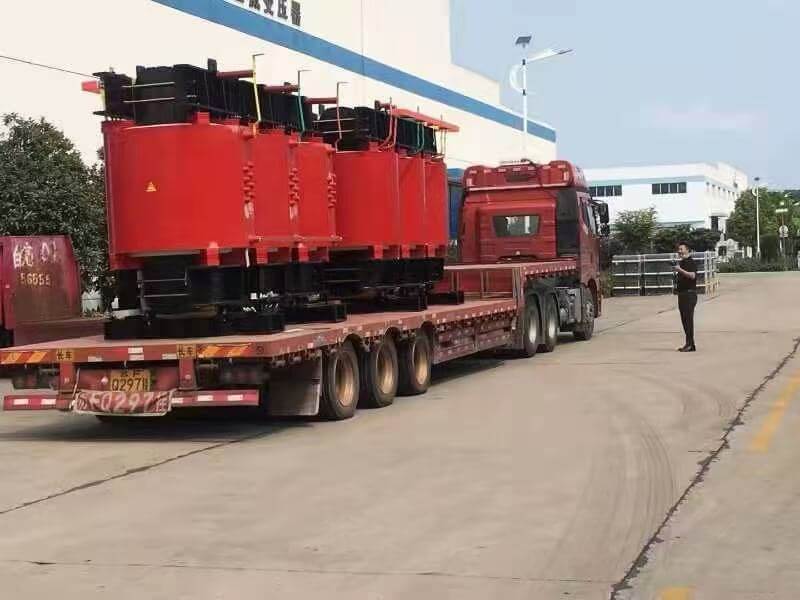
Dry type transformer installation, transportation and operation require careful control of storage conditions, lifting, inspection, testing and commissioning. This guide applies to dry-type distribution transformers rated up to 2500kVA with an insulation voltage of up to 35kV. It covers site protection, delivery acceptance, loading and unloading, pre-commissioning tests, energization and routine supervision.
All work must be carried out by qualified electrical personnel. The product manual, nameplate data, approved drawings and applicable local electrical requirements always take priority during dry type transformer installation and commissioning. For more equipment options, explore our dry-type transformer range.
1. Dry Type Transformer Installation: Site Storage and Protection
Before unpacking, place the transformer on dry, level, ventilated and rain-proof ground. The installation area should be protected from water, dust, vibration and falling objects throughout the construction period.
- Prevent severe impact, collision and unnecessary vibration during transportation, hoisting and positioning.
- Keep underground electrical rooms free from standing water and prevent conductive foreign objects from entering the transformer.
- If energization is delayed after positioning, cover the transformer with moisture-proof material to reduce the risk of dampness and contamination.
- Use protective covers during electrical-room construction to prevent dust, tools and debris from falling into the coil area.
- Install the transformer securely and confirm that the equipment is stable before commissioning.
- Do not allow iron fittings, screws, tools or other debris to accumulate on the transformer body or enter the winding area.
- Do not step, stand or place heavy objects on the transformer during installation work.
- Protect electrical conduits, cables and support structures from collision or mechanical damage.
- Avoid welding work above the transformer. Where welding cannot be avoided, use effective shielding to prevent welding slag from damaging the equipment.
Important: Switch off the temperature-controller power supply before energizing or de-energizing the transformer main circuit.
2. Delivery Inspection and Acceptance
A complete delivery inspection is an important part of dry type transformer installation. Inspect the transformer immediately after delivery and before it is moved into its final operating position.
- Check the model, rated capacity, voltage combination, vector group, impedance voltage and other nameplate data against the packing list and purchase contract.
- Verify that factory documents, test reports, accessories and spare parts are complete.
- Inspect for transport damage, including deformation, displacement, loose fasteners, damaged insulation or contamination on the windings.
- Check that all external components, protective covers and terminals are in good condition.
- If commissioning will not take place immediately, repack and store the transformer indoors in a secure, dry location to prevent moisture, damage and theft.
3. Transportation, Loading and Lifting Requirements
Correct handling protects the winding structure, insulation system and accessories from hidden mechanical damage. Use lifting equipment with suitable rated capacity and follow the approved lifting method for the specific transformer model.
- Use suitable lifting equipment, such as a mobile crane, truck-mounted crane or forklift.
- Follow applicable lifting and loading requirements to ensure safety, stability and zero equipment damage.
- When lifting a packaged transformer, attach wire ropes to the reinforced lower corners of the crate with suitable wood padding.
- When lifting an unpacked transformer, use all integrated lifting lugs at the same time.
- The included angle between lifting wire ropes should not exceed 60°.
- If the transformer tilts during lifting, adjust rope lengths so that the hook aligns with the equipment’s center of gravity.
- When using a forklift, ensure that the transformer’s center of gravity remains correctly positioned between both fork arms.
- Handle the transformer gently throughout loading, unloading and final positioning.
4. Cooling Fan Inspection Before Operation
For transformers exposed to long-distance transportation or extended storage, inspect the cooling-fan assembly before operation. Remove foreign material, check that all connections are tight, and confirm that each fan rotates smoothly without abnormal noise or obstruction.
Verify that the temperature controller can start and stop the fans automatically according to its configured temperature settings. Do not keep cooling fans running continuously unless the manufacturer’s instructions specifically require it.
5. Pre-Commissioning Checks for Dry Type Transformer Installation
5.1 Visual Inspection Before Energization
- Confirm that all accessories removed for transportation have been reinstalled correctly.
- Inspect and retighten loose connectors, fasteners and standard fixing parts.
- Verify that the temperature controller and other auxiliary devices operate normally.
- Confirm reliable earthing of the transformer enclosure and single-point earthing of the iron core assembly.
- Check cable terminations, phase identification and clearance distances before connecting the supply.
5.2 Required Pre-Commissioning Tests
Before energization, perform the required tests in accordance with the manufacturer’s instructions and applicable project requirements. Relevant transformer standards can be reviewed through the IEC transformer standards resources.
- Measure the DC resistance of the windings at all tap positions.
- Verify that the voltage ratio at each tap position matches the nameplate specification.
- Test winding polarity and confirm the vector group marking.
- Remove the core earthing strap and test core insulation using a 2500V megohmmeter. Reinstall the strap after testing and confirm proper single-point core earthing.
- Measure insulation resistance between high voltage and ground, low voltage and ground, and high voltage and low voltage using a 2500V megohmmeter.
- If insulation resistance does not meet the specified requirement, dry the transformer before energization. Suitable methods include hot-air drying, infrared baking or a combined process.
- Raise the drying temperature gradually. Avoid rapid temperature changes and maintain an ambient drying temperature of approximately 60°C to 80°C.
- Do not energize the transformer until insulation resistance has recovered to the factory-specified level.
- For on-site power-frequency withstand-voltage testing, apply 85% of the factory test voltage. Disconnect the temperature controller and sensor plugs before testing, then reconnect them after completion.
- For transformers with on-load tap changers, complete inspection and commissioning according to the dedicated tap-changer manual.
6. Trial Operation and Initial Loading
Energize the transformer only after all inspections and tests have produced satisfactory results. A controlled trial operation is the final stage of dry type transformer installation before normal service.
- Configure the temperature controller and display unit before energization.
- Confirm that the tap position matches both the nameplate and tap-position marking.
- Verify that the transformer phase sequence matches the grid supply phase sequence.
- With all protective devices active, carry out three full-voltage no-load closing operations. Keep an interval of more than five minutes between each operation.
- After no-load energization, operate the transformer for 24 consecutive hours if no abnormal condition occurs.
- After load is applied, monitor temperature readings. Small temperature differences between phases are normal under balanced three-phase loading.
- Record all inspection and test data for future operation and maintenance reference.
7. Tap Position Adjustment and Routine Operation
7.1 Off-Circuit Tap Changer
Before energization, adjust three-phase tap links according to the transformer nameplate and the actual grid voltage. For a transformer rated at 10000±2×2.5% V, the tap positions may be as follows:
- Position 1: 10500V
- Position 2: 10250V
- Position 3: 10000V
- Position 4: 9750V
- Position 5: 9500V
If the actual grid voltage is 10kV, Position 3 is normally used as the factory default setting. All three phases must be adjusted synchronously to the same tap position. Before any tap adjustment, complete high-voltage isolation, line earthing and winding discharge.
For a detailed explanation of off-circuit tap-changing principles, see our guide to off-circuit transformer tap adjustment.
7.2 On-Load Tap Changer and Temperature Control
For transformers fitted with on-load tap changers, complete the required off-line inspection before energization and follow the dedicated tap-changer manual for adjustment procedures.
- Temperature-controller parameters are normally pre-set at the factory.
- When ambient temperature is below 0°C, the controller may not display temperature readings.
- Use the recommended energization sequence: switch off temperature-controller power, energize the transformer main circuit, then restore temperature-controller power.
- Start with no-load energization and add load gradually after confirming that no faults or abnormal conditions are present.
- Monitor temperature readings, automatic fan operation, over-temperature alarms and trip functions.
- A three-phase temperature difference below 10°C is generally acceptable. If the difference exceeds 10°C, inspect the system and rebalance the load where necessary.
Conclusion
Safe dry type transformer installation depends on proper storage, careful lifting, complete pre-commissioning tests and controlled trial operation. Following these procedures helps reduce the risk of moisture damage, insulation failure, incorrect tap settings and avoidable commissioning delays. For customized transformer solutions for utility, industrial and renewable-energy projects, visit our transformer products page.
 English
  Spanish
  Arabic
  French